What Breaks First When a Municipality Outgrows Its ERP
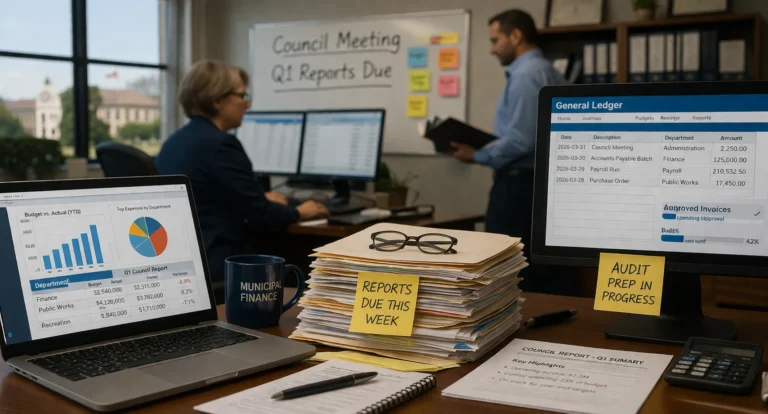
In many Canadian municipalities, the entire finance operation is run by fewer than five people. Those teams are responsible for budgets, payroll, reporting, audits, and council requests, often while working on systems implemented years, sometimes decades, ago.
At the same time, expectations have grown. Councils want faster reporting. Departments want better visibility. Auditors require more documentation. When systems built for a different era are stretched to meet today’s expectations, the strain starts to show.
Not all at once, but gradually. These are the signs municipalities usually see first.
Reporting Starts Taking Too Long
Municipal leaders rely on timely financial information. But when ERP systems begin to fall behind, reporting becomes manual. Staff export data, reconcile spreadsheets, and rebuild reports before sharing them with leadership.
What should take minutes can start taking hours. This becomes especially visible during month-end, year-end, and audit preparation, when timelines matter most and manual processes are hardest to manage
Spreadsheets Become the Real System
Spreadsheets are useful, but they were never meant to run municipal operations.
When budget tracking, capital planning, and department reporting start living in spreadsheets instead of the ERP, complexity grows quickly. Different versions circulate. Formulas change.
Key information lives outside the system. At that point, the ERP is no longer the system of record. The spreadsheets are. And once that happens, version control, data accuracy, and audit confidence all start to become concerns.
Manual Work Starts Taking Over
Small municipal teams often spend time on:
• duplicate data entry
• manual approvals
• report reconciliation
Individually, these tasks seem manageable. Together, they consume a significant
portion of a small team’s time. Every hour spent moving data is an hour not spent supporting leadership, planning, or improving operations
A Reality Many Municipal Teams Recognize
In many municipal offices, there is one person who knows exactly which spreadsheets must be updated to make the numbers balance. It works because experienced professionals make it work. But it also creates risk.
When processes rely on manual workarounds and individual knowledge, the system is no longer carrying the workload. The people are.
Why Municipalities Are Modernizing ERP
More municipalities are starting to modernize their financial systems to reduce manual work and improve efficiency. Modern municipal ERP platforms are designed to eliminate these workarounds by bringing financials, budgeting, payroll, and reporting into a single system.
In practical terms, this allows teams to:
• reduce manual processes
• access real time financial data
• simplify reporting
The goal is not just better technology. It is reducing reliance on manual processes and individual knowledge.
Municipalities are not replacing systems because they want to. They are doing it because the current approach is no longer sustainable. As a result, many are standardizing on Microsoft Dynamics 365 Business Central as the foundation for modern ERP, bringing financials, reporting, and operations into a single, connected system. Solutions like SylogistGov ERP build on this foundation to support the specific needs of local governments.
It Comes Down to Time
For municipalities, modernization is not just about technology.
It is about time.
Time to focus on planning.
Time to support council.
Time to better serve the community.
The Question Many Municipalities Are Starting To Ask:
At what point does the system become the bottleneck?
And how much of your team’s time is actually spent working around it instead of using
it?.
Learn more about SylogistGov ERP
Connect with the Sylogist Team: https://www.sylogist.com/contact/
Explore the SylogistGov ERP: https://www.sylogist.com/gov/erp/