Fundraising Software for Nonprofits: 7 Smarter Ways to Grow Giving

Fundraising success isn't about collecting more donor data. It's about knowing what to do with it.
Fundraisers spend their days building relationships, managing campaigns, researching prospects, and finding new ways to engage supporters.
But when donor information lives across spreadsheets, email inboxes, and disconnected systems, it’s difficult to know where to focus.
Modern fundraising software for nonprofits is changing that. With connected donor data, AI-powered insights, and automation, development teams can make smarter decisions without losing the personal touch that makes fundraising successful.
Here are seven practical ways to put today’s fundraising technology to work.
1. Identify Donors Who May Be Ready to Give Again
Your next fundraising opportunity might already be in your database.
Instead of reviewing hundreds of donor records manually, use fundraising software to identify supporters whose giving patterns suggest an opportunity for renewed engagement.
Try this: Create a list of donors who gave consistently over the past three years but haven’t contributed to your current campaign.
Review their giving history and recent interactions before reaching out.
The advantage: You can prioritize relevant conversations instead of sending the same appeal to everyone.
2. Spot Donor Retention Risks Before It’s Too Late
Donor retention shouldn’t begin after someone stops giving.
Modern fundraising systems can help identify changes in engagement, such as missed recurring gifts, reduced donation frequency, or longer gaps between interactions.
Try this: Build a monthly report of donors who contributed last year but haven’t given this year.
Segment the list by giving history, relationship manager, and recent engagement.
Assign personalized follow-ups rather than immediately sending another donation request.
The advantage: Your team can focus on rebuilding relationships before supporters become completely disengaged.
3. Make Major Gift Meetings More Meaningful
Major gift officers need more than a donor’s contact information before walking into a meeting.
They need context.
A connected fundraising CRM can bring together previous gifts, campaign interests, meeting notes, relationships, and stewardship activity.
AI-assisted summaries can help teams prepare by highlighting relevant information, provided those capabilities are available and configured.
Try this: Before your next donor meeting, review:
The donor’s most recent gifts and areas of interest
Previous conversations and commitments
Outstanding stewardship activities
Potential opportunities for further engagement
Use that information to prepare three thoughtful questions.
The advantage: Better preparation leads to more relevant conversations and stronger donor relationships.
4. Automate the Follow-Up, Not the Relationship
Fundraising is personal. Administration doesn’t always need to be.
Workflow automation can reduce repetitive tasks while keeping fundraisers in control of donor communications.
For example, a configured fundraising system can trigger internal reminders when a donation is received, a pledge approaches its due date, or a stewardship activity is overdue.
Try this: Create a stewardship workflow for major gifts:
Record the gift and generate the appropriate acknowledgment.
Assign a personal thank-you call to the relationship manager.
Schedule a follow-up impact update.
Track completion in the donor record.
The advantage: Every donor receives more consistent attention without relying on manual reminders.
5. Use AI to Prioritize Your Fundraising Pipeline
AI is becoming an increasingly useful tool for nonprofit fundraising, particularly when organizations have reliable donor data.
Depending on the software, AI-powered capabilities may help analyze giving patterns, support fundraising forecasts, and recommend next engagement activities.
However, predictive insights should guide—not replace—a fundraiser’s judgment.
Try this: Compare AI-assisted recommendations with your team’s existing prospect portfolio.
Look for donors whose historical giving, interests, and engagement suggest they deserve a closer review.
Then validate those opportunities with your relationship managers.
The advantage: Your team can spend less time sorting through records and more time cultivating promising relationships.
6. Turn Fundraising Reports Into Weekly Decisions
Reporting shouldn’t be something your team only thinks about before a board meeting.
With real-time dashboards, fundraisers can regularly review campaign performance, pipeline progress, donor retention, and fundraising goals.
Try this: Create a weekly fundraising dashboard with five metrics:
| Metric | Question it answers |
|---|---|
| Donor retention rate | Are supporters continuing to give? |
| Lapsed donors | Who needs renewed engagement? |
| Major gift pipeline | Which opportunities need attention? |
| Campaign progress | Are we on track to meet our goal? |
| Pledge fulfillment | Which commitments require follow-up? |
Use the dashboard to identify one or two actions for the coming week.
The advantage: Reporting becomes a tool for improving fundraising performance, not just documenting it.
7. Connect Fundraising Activity With Financial Results
One of the biggest challenges for nonprofit organizations is disconnected fundraising and finance data.
Development teams track donations and pledges, while finance teams manage gift posting, allocations, restricted funds, and financial reporting.
When these systems don’t communicate, reconciliation and reporting can become time-consuming.
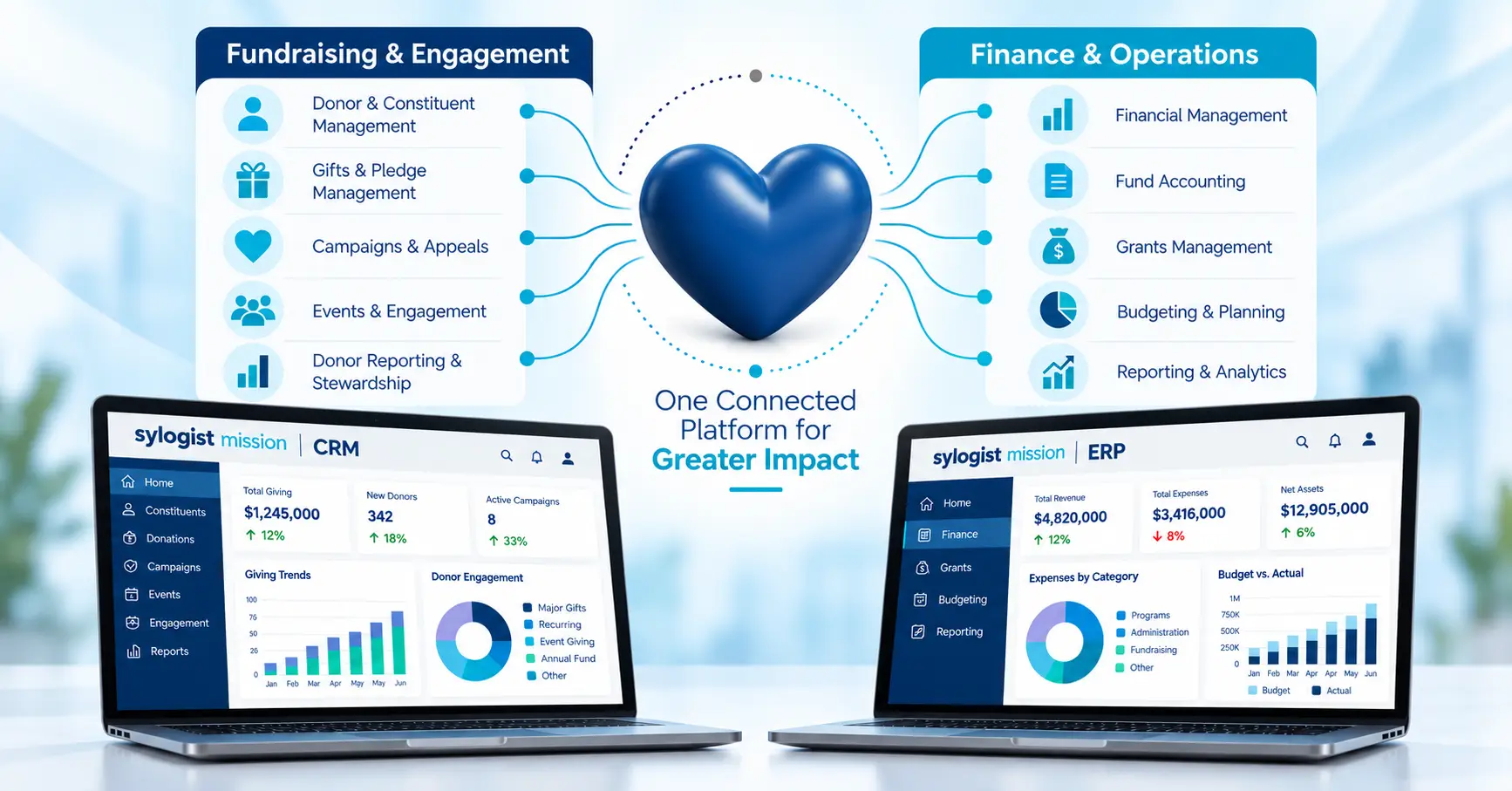
Connected CRM and ERP software can help align fundraising records with financial activity.
Try this: Review how a donation moves from online giving or gift entry into financial reporting.
Identify where staff manually re-enter information, reconcile transactions, or correct inconsistent records.
Those steps may be opportunities for integration or automation.
The advantage: Greater visibility into fundraising performance and less administrative work between departments.
The Future of Fundraising Is Connected
The real value of fundraising software for nonprofits isn’t the number of features it offers.
It’s how effectively those features help your team answer important questions:
Which donors should we engage next?
Which relationships need attention?
Where are our strongest fundraising opportunities?
How can we reduce administrative work?
Are our fundraising efforts producing the results we expect?
When donor management, fundraising activity, reporting, and automation work together, development teams can make better-informed decisions and spend more time building meaningful relationships.
Fundraise Smarter with SylogistMission CRM
SylogistMission CRM, built on Microsoft Dynamics 365 and Azure, helps nonprofits connect donor relationships, fundraising activities, and performance insights in one platform.
With donor management, major gift portfolio tracking, campaign management, stewardship workflows, and reporting, fundraising teams can access the information they need to take meaningful action.
Integration with Microsoft Outlook, Teams, Excel, and Power BI helps connect fundraising with the tools employees already use.
Microsoft AI capabilities can also support donor insights, fundraising forecasting, and recommended next actions.
And for organizations seeking closer alignment between fundraising and finance, SylogistMission CRM can connect with SylogistMission ERP.
Ready to Make Your Fundraising Data Work Harder?
Discover how SylogistMission CRM helps nonprofit fundraising teams improve donor engagement, streamline workflows, and gain greater visibility into fundraising performance.