Best Nonprofit CRM Software: Comparing SylogistMission, Salesforce, Blackbaud, and Bloomerang
Explore four nonprofit CRM platforms and discover how their fundraising, donor management, reporting, and integration capabilities compare.
Choosing the best nonprofit CRM software is about more than managing donor records. Today’s nonprofit organizations need technology that helps fundraising teams strengthen relationships, manage campaigns, track performance, and make informed decisions.
But with so many nonprofit CRM platforms available, how do you determine which solution is right for your organization?
Some platforms prioritize donor engagement and retention. Others offer extensive customization, fundraising intelligence, or connections between fundraising and financial operations.
In this guide, we’ll compare four nonprofit CRM solutions—SylogistMission CRM, Salesforce Nonprofit Cloud, Blackbaud Raiser’s Edge NXT, and Bloomerang—to help you understand their capabilities and identify the right fit for your organization’s goals.
What Should You Look for in the Best Nonprofit CRM Software?
Before comparing vendors, it’s important to understand what your nonprofit needs from its CRM.
A modern nonprofit CRM should do more than store contact information. It should help your team build stronger donor relationships, improve fundraising efficiency, and gain visibility into organizational performance.
When evaluating nonprofit CRM software, consider these six capabilities:
Donor Management: Maintain a complete view of giving history, relationships, interactions, and engagement.
Fundraising and Campaign Management: Track appeals, donations, major gifts, pledges, and campaign performance.
Reporting and Analytics: Access fundraising insights, donor trends, and performance dashboards.
Integration Capabilities: Connect your CRM with finance, email, productivity tools, and other essential systems.
Automation and AI: Reduce repetitive administrative work and identify opportunities to strengthen donor engagement.
Scalability and Support: Choose technology that can adapt to your organization’s evolving needs.
The best solution will depend on how your nonprofit operates today and where it plans to grow.
Comparing Four Nonprofit CRM Platforms
1. SylogistMission CRM: Microsoft-Powered Fundraising and Donor Management
Best suited for: Nonprofits seeking a Microsoft-native fundraising CRM with connected donor management, reporting, and financial visibility.
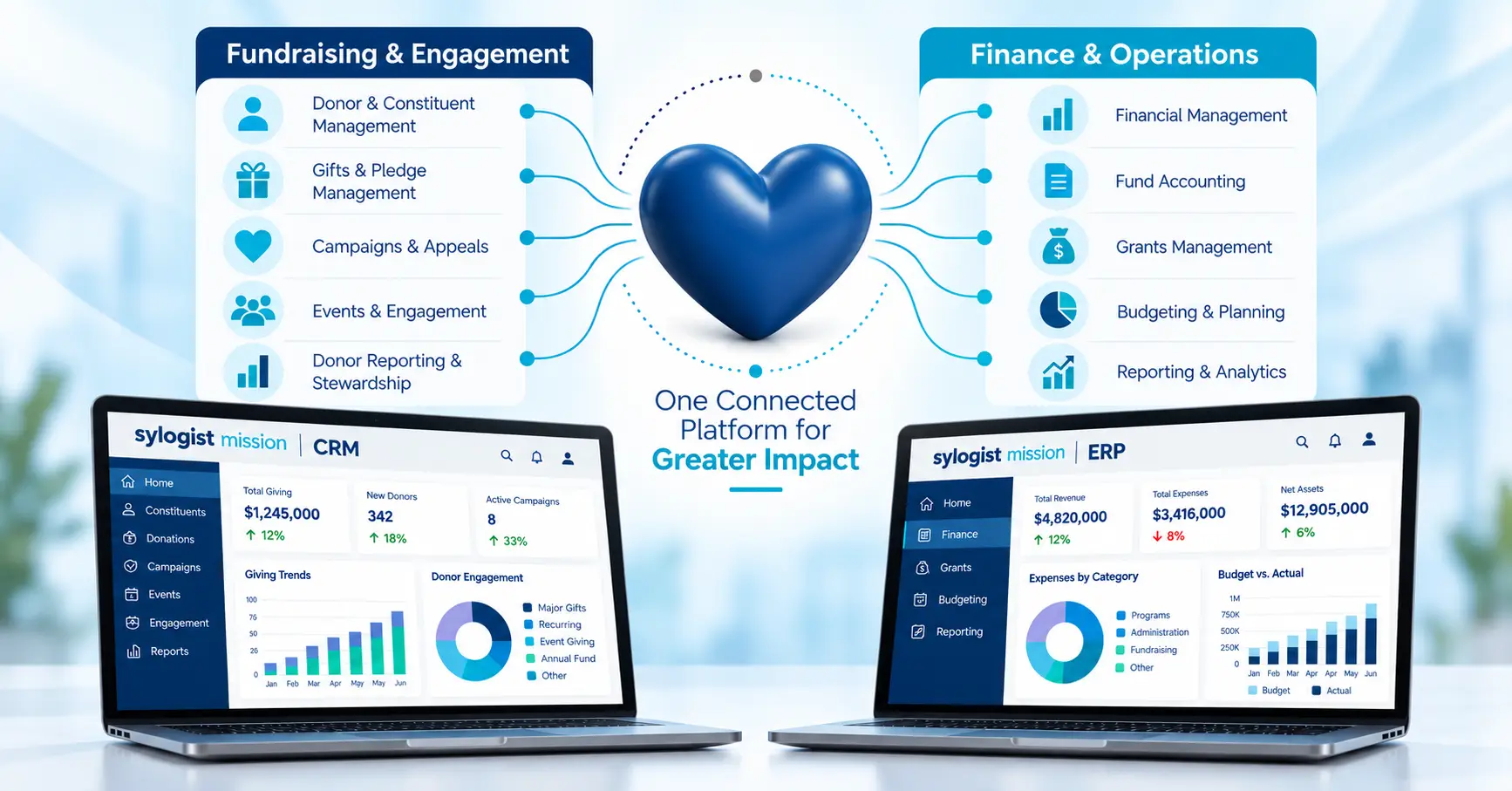
SylogistMission CRM is built on Microsoft Dynamics 365 and designed specifically for nonprofit fundraising and constituent relationship management.
The platform brings donor records, giving history, campaigns, stewardship, and fundraising activity together, helping teams understand their supporters and make more informed decisions.
Key capabilities include:
Centralized donor and constituent relationship management.
Major gifts, portfolio management, and stewardship tracking.
Campaign planning, appeals, and fundraising management.
Microsoft 365 integration with Outlook, Teams, and Excel.
Power BI dashboards and fundraising analytics.
Microsoft Copilot capabilities for donor insights, summaries, and recommended next steps.
Integration with SylogistMission ERP for connected fundraising and financial management.
What makes SylogistMission different?
Its Microsoft foundation is an important consideration for nonprofits already using Microsoft technologies.
Rather than managing fundraising activity separately from everyday productivity tools, organizations can work within a connected Microsoft ecosystem.
For nonprofits looking to align fundraising and finance, SylogistMission CRM can also connect with SylogistMission ERP to support financial reporting, fund accounting, and greater visibility into how donations support organizational activities.
Consideration: Organizations should evaluate their Microsoft environment, implementation requirements, and whether they need CRM capabilities alone or a connected CRM and ERP solution.
2. Salesforce Nonprofit Cloud: Flexible Fundraising and Program Management
Best suited for: Nonprofits looking for a configurable platform that supports fundraising alongside broader program and service delivery activities.
Salesforce Nonprofit Cloud provides nonprofit-focused capabilities built on the Salesforce platform.
Its functionality extends beyond donor management to include program management, volunteer management, and outcome tracking.
Key capabilities include:
Donor profiles and fundraising portfolio management.
Gift processing, commitments, and campaign management.
Program and case management.
Volunteer management.
Outcome measurement and reporting.
Workflow automation and configurable processes.
Access to the broader Salesforce ecosystem.
What makes Salesforce different?
Salesforce offers a broad platform for organizations that want to connect fundraising with other operational activities.
For nonprofits managing complex programs, services, and constituent relationships, its configurable approach may be appealing.
Consideration: Evaluate the configuration, administration, integration, and implementation resources required for your intended use. The scope of a Salesforce deployment can vary significantly depending on the organization’s needs.
3. Blackbaud Raiser’s Edge NXT: Established Fundraising and Donor Intelligence
Best suited for: Fundraising-focused nonprofits looking for donor management, gift tracking, prospect insights, and stewardship capabilities.
Blackbaud Raiser’s Edge NXT is a nonprofit fundraising CRM designed to help development teams manage donor relationships and fundraising performance.
The platform combines constituent information with fundraising workflows, analytics, and AI-powered tools.
Key capabilities include:
Donor and constituent records.
Gift processing and campaign tracking.
Major gift and prospect management.
Fundraising dashboards and performance reporting.
AI-assisted donor insights and recommendations.
Stewardship and relationship management.
Fundraising communications and engagement tools.
What makes Blackbaud different?
Raiser’s Edge NXT emphasizes fundraising intelligence and established development workflows.
Organizations with significant donor portfolios and structured fundraising programs may find its specialized capabilities relevant.
Consideration: Nonprofits should assess how the platform connects with their existing finance systems, productivity tools, and reporting processes, particularly if they want greater visibility across fundraising and financial operations.
4. Bloomerang: Donor Engagement and Retention
Best suited for: Nonprofits prioritizing donor relationships, engagement, retention, and accessible fundraising workflows.
Bloomerang combines donor management, fundraising, engagement, volunteer management, and reporting capabilities.
Its platform emphasizes helping nonprofit teams understand their supporters and build stronger long-term relationships.
Key capabilities include:
Donor profiles and giving history.
Donor engagement and retention insights.
Online fundraising and donation forms.
Email communications and automated donor journeys.
Fundraising events and peer-to-peer campaigns.
Volunteer management.
Reporting dashboards and AI-powered insights.
What makes Bloomerang different?
Bloomerang emphasizes donor engagement and fundraising workflows that help teams build stronger supporter relationships.
For organizations focused on recurring giving, stewardship, and retention, these capabilities may be particularly relevant.
Consideration: Organizations with complex financial structures, extensive customization needs, or specialized integrations should confirm how Bloomerang fits into their broader technology environment.
Nonprofit CRM Comparison: At a Glance
| CRM platform | Primary strengths | Worth evaluating for |
|---|---|---|
| SylogistMission CRM | Microsoft-native CRM, fundraising, donor management, Power BI, connected ERP | Nonprofits seeking connected fundraising, finance, and Microsoft integration |
| Salesforce Nonprofit Cloud | Configurable fundraising, program management, volunteer management, outcomes | Organizations managing fundraising alongside complex programs and services |
| Blackbaud Raiser’s Edge NXT | Fundraising workflows, donor intelligence, major gifts, stewardship | Development teams focused on fundraising and donor portfolio management |
| Bloomerang | Donor engagement, retention, fundraising, communications, volunteers | Nonprofits prioritizing donor relationships and accessible fundraising workflows |
This comparison summarizes areas of emphasis based on publicly documented vendor capabilities. It is not a feature-by-feature ranking; availability may vary by edition, licensing, configuration, and integrations.
Five Questions to Ask Before Choosing Nonprofit CRM Software
Even after narrowing your options, selecting the best nonprofit CRM software requires understanding how each solution will support your team in practice.
1. Can Your CRM Provide a Complete View of Donors?
Your fundraising team needs more than names and donation amounts.
A useful nonprofit CRM should help staff understand giving history, communication preferences, past interactions, campaign involvement, and stewardship opportunities.
Ask vendors to demonstrate how a fundraiser can prepare for a major gift meeting using information already stored in the CRM.
2. How Easily Does Your CRM Connect with Financial Management?
Fundraising and finance teams often rely on different systems, creating additional work when donations need to be reconciled, allocated, and reported.
When evaluating nonprofit CRM platforms, ask:
How does donation information flow into our accounting system?
Can we track gifts and designations accurately?
How much manual reconciliation will our finance team need to perform?
Can leadership access fundraising and financial information together?
For nonprofits with complex funds, grants, or restricted giving, these questions are especially important.
3. Does the Platform Work with Your Existing Technology?
Your nonprofit likely already relies on email, spreadsheets, collaboration tools, financial systems, and reporting applications.
The best nonprofit CRM software should fit into your existing technology environment without creating unnecessary administrative work.
For organizations using Microsoft 365, a Microsoft-native CRM such as SylogistMission may provide advantages worth exploring.
For organizations using other technology ecosystems, integration compatibility should be a central part of the evaluation.
4. Can Your Team Turn Donor Data into Action?
Reporting is useful, but actionable insights can help fundraising teams make better decisions.
Look for capabilities that help answer questions such as:
Which donors are showing signs of reduced engagement?
Which major gift opportunities need follow-up?
How are campaigns performing against their goals?
Which supporters may be ready for additional engagement?
What information does leadership need to make timely decisions?
Many modern nonprofit CRM platforms now offer analytics, automation, and AI capabilities. Evaluate how these features work with your organization’s data and fundraising processes.
5. Will the CRM Support Your Organization as It Grows?
Your organization’s needs may change as fundraising programs expand, new teams are added, or reporting requirements become more complex.
Before making a decision, consider the platform’s flexibility, implementation approach, support model, and long-term costs.
A CRM should support your organization’s future, not simply solve today’s most immediate challenges.
Why Microsoft Integration Matters When Comparing Nonprofit CRMs
One important consideration that nonprofits sometimes overlook is how their CRM connects with the technology employees already use.
For organizations working in Microsoft Outlook, Teams, Excel, and Power BI, disconnected fundraising systems can create extra steps when tracking communications, preparing reports, or collaborating across departments.
SylogistMission CRM is built on Microsoft Dynamics 365 and designed to work within the Microsoft ecosystem.
This allows nonprofits to bring together donor management, fundraising activities, reporting, and collaboration through familiar tools.
With Microsoft Copilot and Power BI capabilities, organizations can also explore opportunities to improve fundraising insights, automate workflows, and support more informed decision-making.
And when paired with SylogistMission ERP, nonprofits can extend that connected approach to financial management and reporting.
For organizations looking to reduce disconnected systems, this can be an important consideration when evaluating nonprofit CRM platforms.
Which Nonprofit CRM Software Is Right for Your Organization?
There is no single CRM that is the best choice for every nonprofit.
A smaller organization focused primarily on donor engagement may have different priorities than a healthcare foundation managing major gifts, a university advancement office coordinating alumni relationships, or a faith-based organization overseeing multiple entities.
The right platform depends on your fundraising strategy, operational complexity, existing technology, and long-term goals.
If your organization prioritizes donor retention and engagement, Bloomerang may be worth exploring.
If you need configurable fundraising and program management capabilities, Salesforce Nonprofit Cloud may be a strong candidate.
If your focus is established fundraising workflows and donor intelligence, Blackbaud Raiser’s Edge NXT may meet your requirements.
And if you’re looking for a Microsoft-native nonprofit CRM that connects donor relationships, fundraising, reporting, and financial management, SylogistMission CRM deserves a closer look.
Ultimately, choosing the best nonprofit CRM software means finding technology that helps your team spend less time managing systems and more time advancing your mission.
Explore SylogistMission CRM
Looking for a nonprofit CRM that connects fundraising, donor engagement, and reporting on Microsoft Dynamics 365?
Discover how SylogistMission CRM helps nonprofits build stronger donor relationships, streamline fundraising workflows, and gain greater visibility into performance.